

Healthcare AI Industry Report
Practical guidance for industry leaders as healthcare AI moves toward deployment at scale.
The 2026 Healthcare AI Industry Report translates the rapidly expanding evidence base into practical guidance for industry leaders as healthcare AI moves toward deployment at scale.
Ethan Goh, Adam Rodman, Jonathan H Chen
Supported by






Questions Industry Leaders are Asking
This report addresses and draws on 2 questions shaping Healthcare AI deployment in 2026.
How is safety measured for current AI systems, and against what comparator?Safety is measured separately from capability/performance, and best-in-class models still risk severe harm in ~1 in 14 consultations. However, error rates only mean something when judged against what care the patient would otherwise get, and evaluation needs to shift toward real patient outcomes as AI surpasses human baselines.
Does stronger model performance actually reach the patient?Strong model performance doesn't reliably translate to better patient outcomes, since physician+AI teams often beat physicians alone but still underperform AI alone, showing that turning raw model capability into real-world impact requires better workflows, interfaces, and training to close the gap.
Key Takeaways
What healthcare AI leaders should know in 2026
Chapter 1
AI capability is outpacing safety evaluation
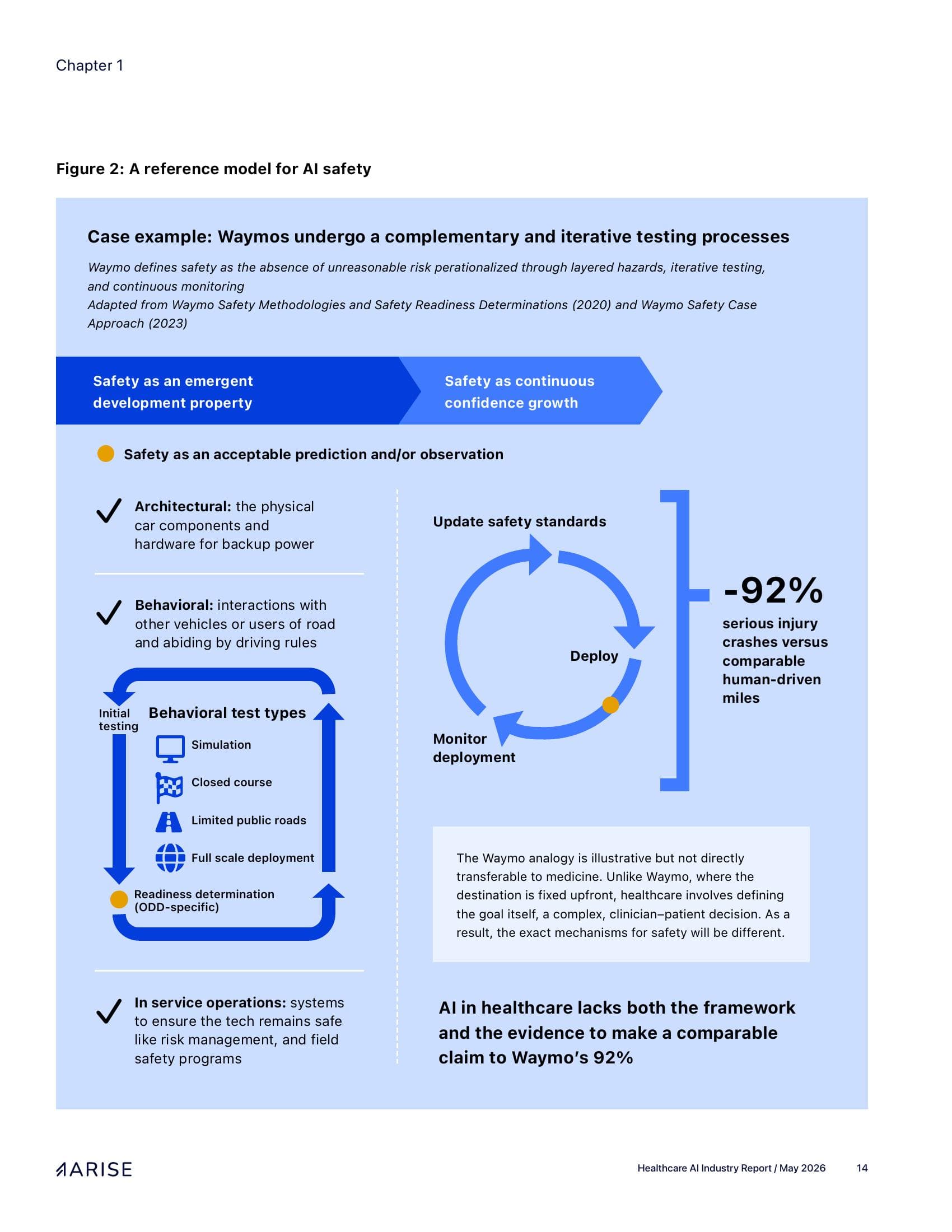
Measure safety as its own dimension, including with dedicated safety benchmarks such as NOHARM, because a more capable model is not automatically a safer one.
On NOHARM, a clinical safety benchmark, even the best-performing models produced recommendations with potential for severe harm in roughly 1 in 14 consultations, with failures of omission driving most serious errors. Strong performance on capability benchmarks does not predict safe clinical behavior.
Validate models on local data before deployment and monitor them after go-live.
Performance can shift when a model is used on a new population, in a new workflow or after a model update. After deployment, because performance can silently degrade over time, evaluation should be reviewed on a defined cadence, with additional checks after workflow, data or model changes.
Assign institutional ownership for AI evaluation.
Public benchmarks and vendor-reported performance can inform early screening, but they should not substitute for local validation. No public benchmark fully matches an institution’s patients, workflows, data environment or deployment context, and vendor claims are not designed to answer whether a tool is safe and effective for a specific local use case.
Chapter 2
Accuracy is not outcomes
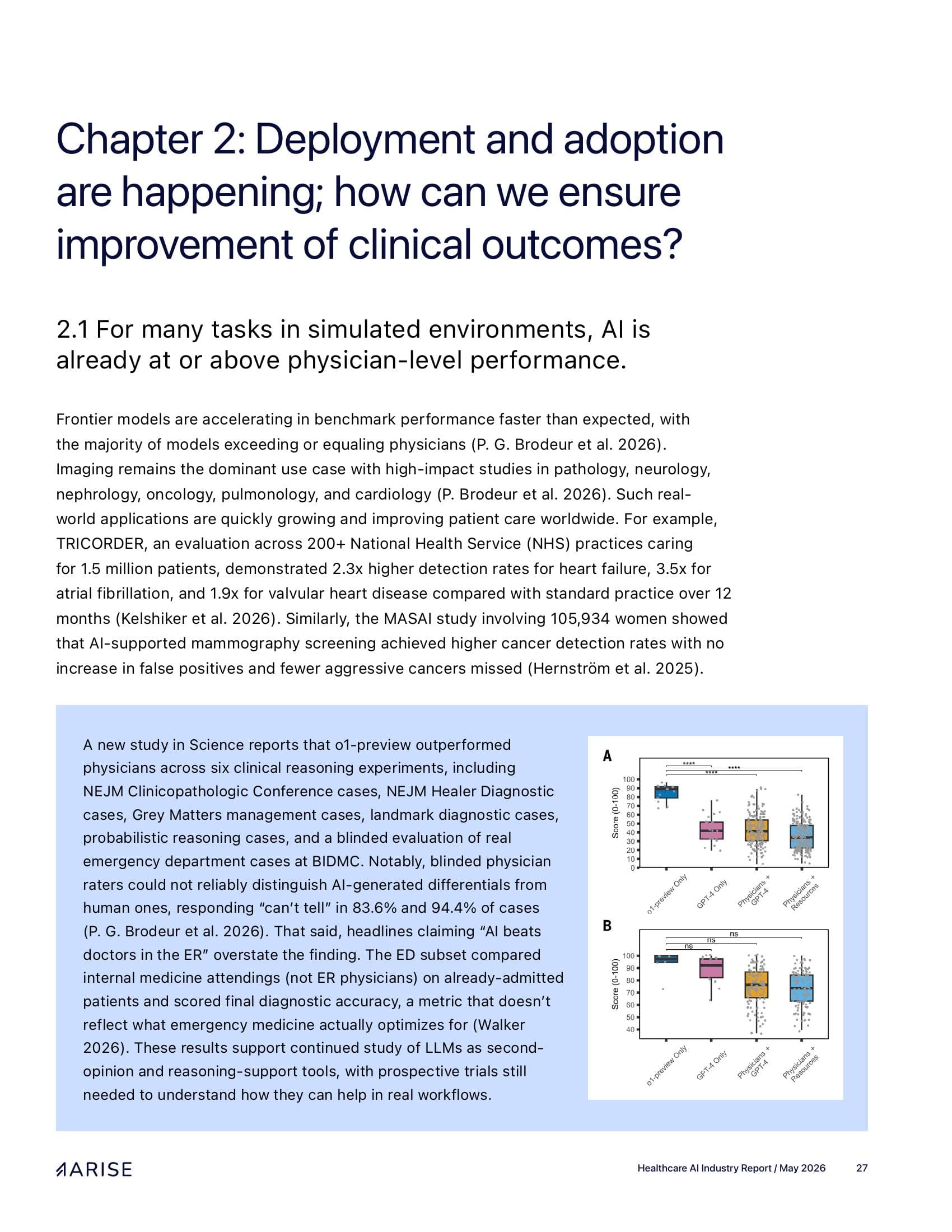
Evaluate the clinician-AI team, not the model alone.
A model that performs well in isolation may deliver less benefit, or create new risks, once placed inside a clinical workflow. Human-AI collaboration studies already show this gap: clinicians using AI often outperform clinicians alone, but still fall short of AI alone. Closing that gap is not simply a training problem. It requires deliberate interface design, workflow design, escalation rules, and real-world studies that identify where models and clinicians each fail.
Preserve clinician agency where human oversight is required.
Clinicians should be trained to interrogate AI outputs, probe uncertainty, and override recommendations when appropriate. At the same time, requiring human review for every AI-supported task can create the appearance of safety without delivering it, especially where clinician time, access, or resources are constrained. The central question is not whether humans should always remain “in the loop,” but which tasks can safely move toward greater autonomy, under what safeguards, and with what escalation pathways. Answering that question requires a taxonomy of clinical and administrative work, paired with measurement of current human performance, risk, cost, and access constraints.
Measure the pathway from AI output to patient benefit.
Strong accuracy, detection or reasoning performance should not be treated as proof that a tool improves care. For clinical tools, the relevant question is whether AI changes decisions, workflows and patient trajectories in intended ways. Health systems should measure downstream effects where feasible, including management changes, escalation, referrals, testing, time to diagnosis, hospitalizations, complications, mortality, cost and patient experience. Where patient-outcome evidence is impractical or too slow, proxy measures may be appropriate, but they should be chosen deliberately and interpreted with their limitations clear.
How to cite
Perez, A., Tusty, M., Liu, C., Wegner, L., Dutta Gupta, N., Kanjee, Z., Morgan, D., Jain, P., Mehta, R., Walton, C., McCoy, L., Nateghi Haredasht, F., Eltahir, A. A., Bielick, C., Griot, M., Lopez, I., Lacar, K., Schoeffler, A., Shah, P., Fathy, R., Han, B., Zheng, A., Anyaegbuna, C., Wu, D., Ravi, V., Brodeur, P., Handler, R., Manrai, A., Zwaan, L., Rodman, A., Goh, E., & Chen, J. (2026). The 2026 Healthcare AI Industry Report. ARISE, Stanford, CA.
Acknowledgements
The authors would also like to thank Marshall Berton, Abigail Foresman, Sarah Jabbour, Zina Jawadi, Samuel O'Brien, Katherine Ropers, Macy Toppan, John Emmett Worth, and David J. Wu for their contributions. They would especially like to thank Joel Koh, Rebekah Lee, and Michi Turner for the report design.